People Strategy can sound like something designed for big companies with HR departments, organisational charts covering several floors and enough people to justify a three-year workforce plan.
If you run a small business, it can feel like a sledgehammer to crack a walnut.
But you don’t need hundreds of employees before you need to think strategically about your people.
You might want to grow the business, take more time away from it or eventually sell. Yet every question still comes to you because the important knowledge lives in your head. You’re checking work, solving problems and getting dragged into things other people should be able to handle. Perhaps you keep hiring but never seem to create any more capacity.
That’s already a People Strategy problem.
Your people can help you build the business you want.
But only if you create the conditions that allow them to.
What does a People Strategist actually do?
A People Strategist starts with where your business is going.
What are you actually trying to create?
Perhaps you want to double the size of the business. Perhaps you’re happy with its size but want it to rely on you far less. Perhaps you’d like to sell one day and need to know that the business can operate successfully under somebody else’s ownership.
Once that destination is clear, you can work backwards.
What does the business need to be capable of to get there? What skills and experience do you need? What should different people be responsible for? Where should decisions be made? What knowledge needs to come out of your head? What systems, processes and ways of working will make that possible?
That’s how I approach People Strategy.
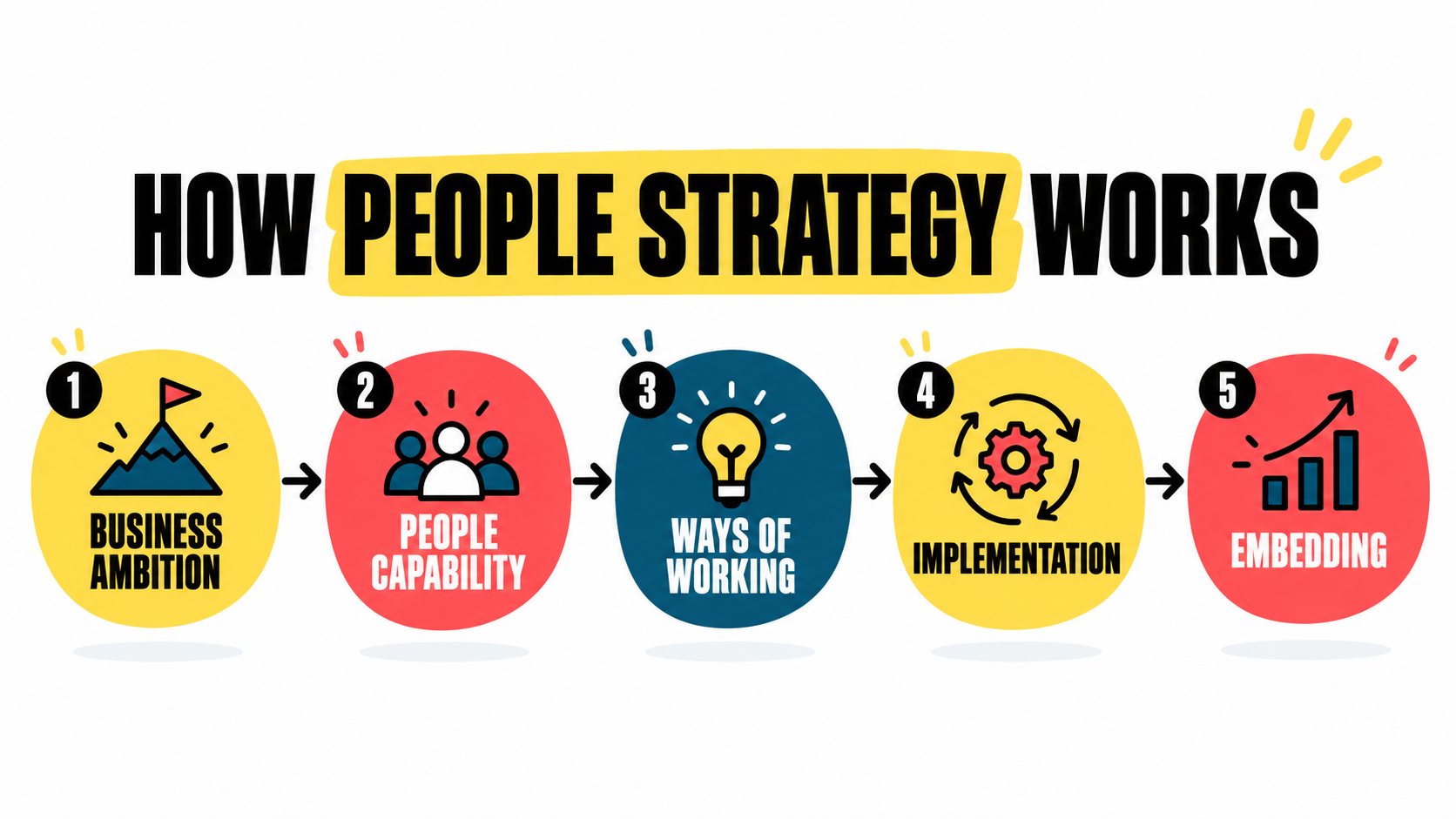
That final embedding part is super-important and it’s why I help my clients implement the changes too.
You can create a new company structure, rewrite everybody’s roles or introduce a shiny new process. None of it will make much difference if everybody just carries on doing what they did before.
People need to understand what’s changing, why it matters and what they are expected to do differently. The new way of working then needs to be reinforced until it becomes habit and how the business operates rather than the initiative everyone talked about for three weeks and then forgot about.
How is a People Strategist different from an HR Consultant?
There is overlap, and good HR Consultants can absolutely provide strategic advice.
The difference is often where the conversation starts.
Traditional HR support is frequently brought in because something has already happened.
Someone isn’t performing. There’s been a complaint. A grievance has been raised. A manager needs help handling a difficult employee. The business has grown and suddenly realises its contracts, policies or handbook need sorting out.
Those are all legitimate things to need to address but my interest is typically further upstream.
If somebody’s performance has become serious enough that you’re considering formal action, what happened during the previous six months?
Were expectations ever clear? Did anybody give them useful feedback? Was their manager equipped to deal with the problem? Did everybody just avoid an awkward conversation until the problem became impossible to ignore?
If several good employees have left, replacing them might solve today’s vacancy and getting a bum back in a seat, but it doesn’t tell you why people keep leaving.
That’s where People Strategy and strategic HR come in. The immediate symptom may still need dealing with, but we also look at what is creating it.
Because solving the same problem over and over again gets very tiring and expensive.
What does People Strategy look like in practice?
It’s usually, much less corporate than people imagine. It can start with an owner saying:
“I’m in everything.”
“I’m busy all day, but I don’t know what I actually achieved.”
“Everything comes back to me.”
“I can’t focus on sales or strategy because I’m dealing with everything else.”
“I want people to take more responsibility, but I don’t trust them to do it properly.”
Those problems rarely have one neat HR solution.
You may need to get clearer about what you as the owner should actually be doing and what somebody else can own.
That could mean clarifying roles and responsibilities, getting important knowledge out of your head, improving onboarding or giving people more authority to make decisions. It might also mean getting much better at addressing poor performance instead of letting it drift.
And sometimes you need to look at the owner’s behaviour too because it’s easy to say you want people to take ownership. It’s much harder to stop stepping in when somebody does something differently from you.
You can tell people they’re responsible for an outcome and then second-guess every decision they make. You can say you trust somebody and still insist that they check everything with you. You can avoid setting firm expectations because you don’t want to upset someone, then become frustrated when they don’t deliver what you wanted.
That environment teaches people to bring things back to you and in doing so, it gradually reinforces your belief that you don't have a competent team you can trust.
This is also why hiring more people won’t fix a business that makes it difficult for good people to do good work.
You can hire until you’re blue in the face! But if those people arrive into unclear roles, blurred responsibilities, weak onboarding, poor communication and a business where the owner is still the answer to every question, they aren’t going to magically sort it out for you.
They might even leave.
Before asking whether you need better people, it’s worth asking whether you have created a business where good people have a fair chance of succeeding.
When might your business need a People Strategist?
There usually isn’t one single trigger.
The businesses I work with typically have some kind of ambition or change ahead of them, but the people side of the business is making it harder than it needs to be.
Growing the business
Growth is an obvious one, but simply adding headcount doesn’t create capacity.
If every new customer, project or employee creates more work for the owner, eventually this approach stops working.
You might already be working ridiculous hours. You might spend your time checking work, answering questions, recruiting, resolving problems and filling gaps. So the things only you can really do, such as sales, strategy, developing new opportunities or thinking about where the company goes next, get pushed further down the list.
At that point, another hire isn’t necessarily the answer.
The question is what capability the business needs to grow without creating an equally large increase in dependency on you.
That might mean recruiting, but it could just as easily mean getting more from the capability you already have and shifting responsibility away from the owner.
Because if adding more work always means adding more of you, you haven’t created capacity for growth.
Stepping back
For some owners, the ambition has very little to do with getting bigger.
They just want their life back!
They want to go on holiday without packing the laptop. They want to finish work and actually be mentally present with their family. They don’t want to be the first port of call for every question.
They want to stop feeling as though the business is permanently running in the background of their head.
You can’t achieve that simply by deciding to work fewer hours. Your responsibility has to go somewhere. In a small business, that doesn’t necessarily require layers of management; it might simply mean trusting and enabling people to own the work they are already closest to.
The aim is for decisions to happen where the work happens, with accountability alongside that autonomy.
Only then does stepping back become something more meaningful than checking your emails from a different location.
Preparing to exit
An owner planning to sell has another version of the same challenge.
A buyer needs to know they are buying a functioning business rather than a job currently being performed by the owner.
If the important client relationships belong entirely to you, key information sits in your head, everybody relies on you to solve problems and performance drops whenever you aren’t there, the business carries significant people risk.
There is also succession to think about.
Who can take on greater responsibility? Where are the knowledge gaps? What happens if a key person leaves?
Retention matters here too. A business experiencing repeated employee turnover loses knowledge, stability and confidence, all of which make transition harder.
If the business only works because you’re holding it together, what exactly is somebody else buying?
These things are considerably easier to address before a potential buyer is asking the questions.
What changes when you start thinking strategically about your people?
The biggest change is that your people decisions stop happening in isolation.
You don’t hire somebody simply because everyone is busy. You work out what capability is actually missing.
You don’t promote your best employee because somebody needs to manage the team. You consider whether they have the ability and desire to lead people, and what support they’ll need to succeed.
You don’t add another process because something went wrong once; you understand what caused the problem first.
People know what they’re responsible for, have what they need to do it well and can make appropriate decisions without everything travelling back to the owner.

That gives the owner something incredibly valuable: capacity.
Capacity to think.
Capacity to take time away.
Capacity to work on the future instead of constantly servicing the present.
It also creates a better working environment for everyone else.
Richard Branson has put the principle simply: “If you take care of your employees, they will take care of your business.”
Gallup’s extensive research backs up the broader point too, consistently linking high employee engagement with better outcomes including profitability, productivity, quality and customer loyalty.
That doesn’t mean keeping everybody happy all the time.
A good working environment still involves accountability, difficult conversations, high expectations and sometimes decisions people won’t like.
People are far more likely to enjoy their work when they know what they’re doing, have what they need to do it well, understand why it matters, feel trusted to make decisions and can talk openly when something isn’t working.
That’s commercially powerful.
Good people are more likely to stay. They can perform at their best. Problems get dealt with before they become crises. The owner doesn’t have to carry everything personally.
The goal shouldn't simply be to build a business that works. It’s to build one that works without draining the life out of the people inside it, including you!
People Strategy should help you build the business you actually want
There are no prizes for growing a successful business that you’ve accidentally made yourself indispensable to.
And there’s little point building a team if the environment around them prevents them from doing the very things you hired them to do.
My approach to People Strategy starts with the business you want to create, then works backwards to what your people need to be capable of and what needs to change to get you there.
Because taking your business to its next stage doesn’t have to rest entirely on you.
You already have, or can build, a team capable of helping you get there. Your job is to create the conditions that allow them to.
If the people side of your business is getting in the way of where you want to go, you can find out more about how I work with business owners on my Work With Me page.